
What Is Ayurveda? Principles, Doshas and Lifestyle Explained for Beginners
Vaidya Mitra Editorial Team (replace with the real author's name, and add the name of the Vaidya who reviewed the article if possible)
03-11-2026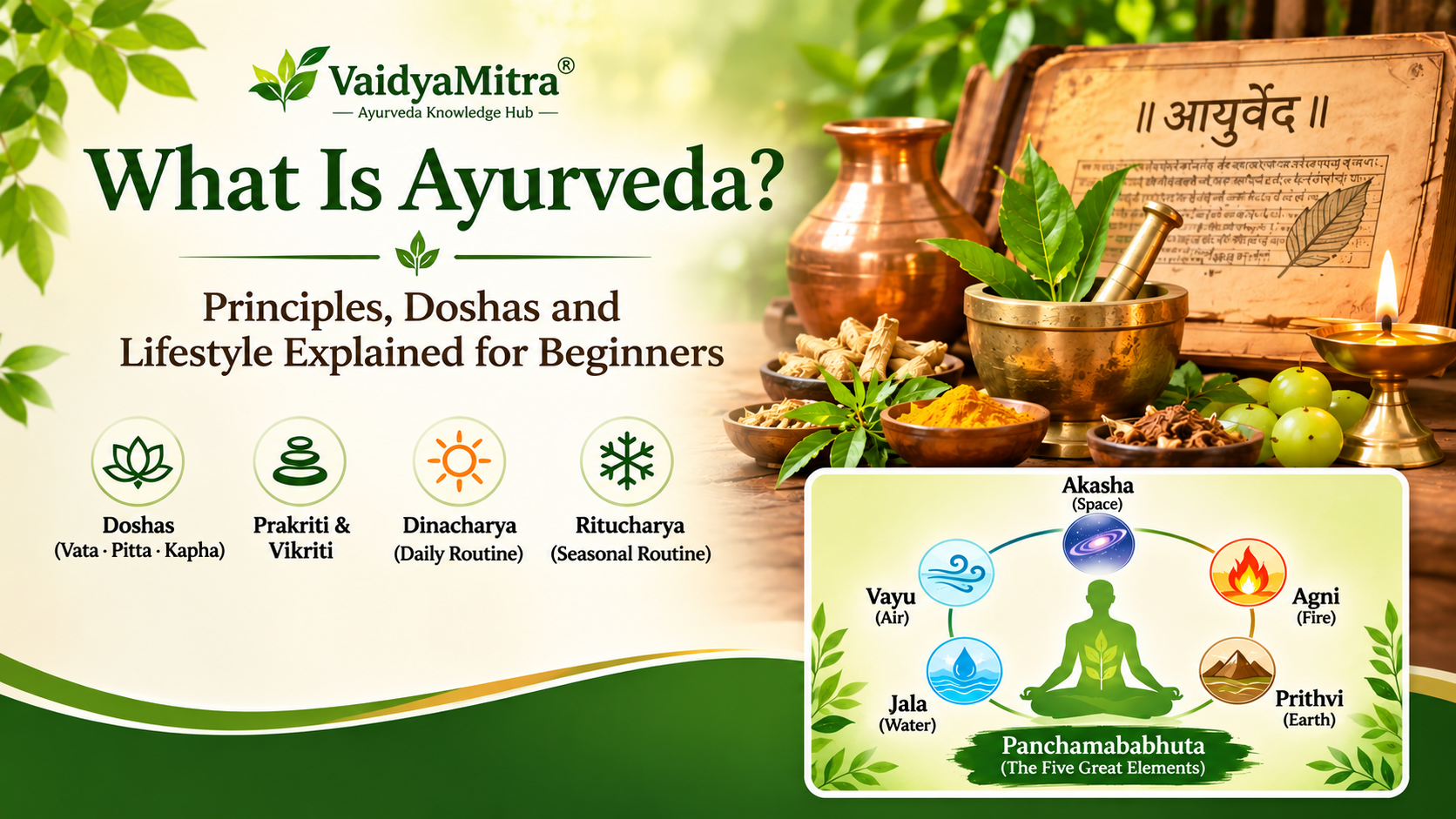
New to Ayurveda? Learn what it is, how the five elements and three doshas work, what Prakriti and Vikriti mean, and how daily and seasonal routines shape an Ayurvedic lifestyle.
What Is Ayurveda? Principles, Doshas and Lifestyle Explained for Beginners
Ayurveda is one of the world's oldest traditional systems of health. The word comes from Sanskrit: Ayus means life and Veda means knowledge or science. Put together, Ayurveda means "the knowledge of life."
It is not only about treating illness. Ayurveda looks at the whole person: body, mind, senses and spirit, and also food, sleep, daily habits and the season of the year. This guide explains the basic ideas in simple language, so you can understand how Ayurveda thinks before going deeper into any topic.
Contents
- What is Ayurveda?
- The core principles of Ayurveda
- Panchamahabhuta: the five great elements
- The three doshas: Vata, Pitta and Kapha
- Prakriti and Vikriti
- Dinacharya: the daily routine
- Ritucharya: the seasonal routine
- Ayurvedic lifestyle: the three pillars
- Ayurveda terminology made simple
- Frequently asked questions
1. What Is Ayurveda?
Ayurveda developed in India over thousands of years. Its knowledge is recorded in classical texts such as the Charaka Samhita (mainly internal medicine), the Sushruta Samhita (mainly surgery) and the Ashtanga Hridaya. Practitioners are called Vaidyas.
Ayurveda has two stated aims. The first is to protect the health of a healthy person. The second is to treat disease in a person who is unwell. This is why so much of Ayurveda deals with everyday living, and not only with medicines.
Today Ayurveda is practised in India as a recognised system of medicine, regulated by the Ministry of Ayush and the National Commission for Indian System of Medicine (NCISM), and it is followed by people in many other countries as well.
2. The Core Principles of Ayurveda
A few ideas run through almost every Ayurvedic concept:
- Every person is unique. Two people with the same complaint may be advised different food, routines or treatments, because their constitution is different.
- Health is balance. Ayurveda describes health as a balance of the doshas, digestion (agni), tissues (dhatus), waste removal (malas), and a content mind and senses.
- Mind and body are connected. Stress, sleep and emotions are seen as part of health, not as separate topics.
- Like increases like, opposites balance. A quality that is already high in you (for example, dryness) tends to increase with more of the same, and is balanced by its opposite (for example, warmth and oil).
- Prevention comes first. Daily and seasonal routines are meant to keep a person healthy before problems begin.
3. Panchamahabhuta: The Five Great Elements
Ayurveda says that everything in nature, including the human body, is made from five great elements, called Panchamahabhuta:
- Akasha (space): the openness in which everything exists.
- Vayu (air): movement.
- Agni or Tejas (fire): heat, transformation and digestion.
- Jala (water): fluidity and cohesion.
- Prithvi (earth): structure, solidity and stability.
These elements combine in different proportions to form the three doshas. They are also used to describe foods, herbs and even seasons.
4. The Three Doshas: Vata, Pitta and Kapha
The doshas are the central idea of Ayurvedic physiology. Think of them as three functional energies that govern the body and mind.
Vata (air and space) governs movement: breathing, circulation, nerve signals, elimination and thought. Its qualities are dry, light, cold, rough and mobile. When Vata is in balance, a person is typically energetic and creative. Ayurveda links excess Vata with irregular digestion, dryness, restlessness and disturbed sleep.
Pitta (fire and water) governs transformation: digestion, metabolism, body temperature, sharp thinking and skin glow. Its qualities are hot, sharp and slightly oily. Balanced Pitta is associated with good digestion, focus and confidence. Excess Pitta is linked with heat, irritability and acidity.
Kapha (water and earth) governs structure and lubrication: the body's build, joints, immunity, stamina and calm. Its qualities are heavy, slow, cool and smooth. Balanced Kapha gives strength and steadiness. Excess Kapha is linked with heaviness, sluggishness and congestion.
Dosha
Elements
Main role
Key qualities
Vata
Air + Space
Movement
Dry, light, cold, mobile
Pitta
Fire + Water
Transformation
Hot, sharp, oily
Kapha
Water + Earth
Structure
Heavy, slow, smooth
Everyone has all three doshas. What differs is the proportion.
5. Prakriti and Vikriti
Prakriti is your natural constitution, the dosha proportion that Ayurveda says is set at birth. It is considered fairly stable through life and explains tendencies in body type, appetite, sleep and temperament. Some people are mainly Vata, Pitta or Kapha, and many are a combination, such as Vata-Pitta.
Vikriti is your current state, meaning how your doshas are right now. It changes with food, stress, sleep, age, season and illness.
A Vaidya compares the two. The aim is generally to bring the Vikriti back toward the Prakriti. This is why a careful consultation, with questions, observation and examination, matters more than any online quiz. Online dosha quizzes can be a useful starting point for learning, but they are not a diagnosis.
6. Dinacharya: The Ayurvedic Daily Routine
Dina means day and charya means conduct. Dinacharya is a daily routine designed to keep the body and mind in rhythm. Classical texts suggest practices such as:
- Waking up early, before or around sunrise
- Attending to natural urges and morning hygiene
- Tongue scraping and oral care
- Gentle exercise or yoga suited to your strength
- Self-massage with oil (Abhyanga) before bathing, where suitable
- Eating the main meal at midday, when digestion is considered strongest
- A lighter evening meal, and going to bed at a regular time
The details differ by person and season, so treat this as a framework and not a strict rulebook.
7. Ritucharya: The Seasonal Routine
Ritu means season. Ritucharya teaches that food, activity and lifestyle should change as the weather changes, because each season affects the doshas differently. Ayurveda traditionally describes six seasons:
- Shishira (late winter)
- Vasanta (spring)
- Grishma (summer)
- Varsha (monsoon)
- Sharad (autumn)
- Hemanta (early winter)
For example, spring is traditionally associated with Kapha building up as the cold melts away, so lighter foods and more activity are suggested. In hot summer, cooling and hydrating foods are favoured, and in the monsoon, easily digestible meals are advised. Since India has regional climates, the exact season dates and advice are adapted to where you live.
8. The Ayurvedic Lifestyle: Three Pillars
Classical Ayurveda names three supports of life, called Trayopastambha:
- Ahara (food): eat fresh, seasonal, suitably cooked food, in the right amount, at the right time.
- Nidra (sleep): regular, sufficient sleep is treated as essential to health.
- Brahmacharya (balanced conduct): moderation in energy use and sensory indulgence, often interpreted today as a balanced, disciplined way of living.
Many people begin with just two or three small habits: regular meal times, a consistent bedtime and warm, freshly prepared food.
9. Ayurveda Terminology Made Simple
Term
Simple meaning
Vaidya
An Ayurvedic physician
Dosha
The three functional energies: Vata, Pitta, Kapha
Dhatu
The seven body tissues
Mala
Waste products of the body
Agni
Digestive and metabolic fire
Ama
Undigested or improperly processed material, seen as a root of imbalance
Prakriti
Natural constitution
Vikriti
Current state of imbalance
Panchakarma
Five cleansing and detoxification therapies
Rasayana
Rejuvenation therapy and practices
Pathya / Apathya
What is suitable / unsuitable for a person
10. Frequently Asked Questions
What is Ayurveda in simple words? Ayurveda is a traditional Indian system of health that focuses on balance between body, mind and lifestyle, and on personalised advice for each individual.
What are the three doshas? Vata (movement), Pitta (transformation) and Kapha (structure). Each person has all three in a different proportion.
What is the difference between Prakriti and Vikriti? Prakriti is your natural constitution. Vikriti is your present state of balance or imbalance.
Can I find my dosha online? Online quizzes can introduce the idea, but a proper assessment is made by a qualified Vaidya after a consultation.
Is Ayurveda a replacement for modern medicine? No. Ayurveda can complement healthy living, but anyone with a medical condition, who is pregnant, or who takes regular medication should consult a qualified doctor before changing treatment. Never stop prescribed medicines without medical advice.
Where should I start if I am a beginner? Start with simple routines: regular meal and sleep times, seasonal fresh food, and learning your basic constitution through a consultation with a registered Vaidya.
Conclusion
Ayurveda is best understood as a way of living and not only a set of treatments. Its ideas, the five elements, the three doshas, Prakriti and Vikriti, and daily and seasonal routines, all point to one message: health comes from balance, and balance looks different for every person.
If you want to explore further, read our guides on each dosha, on Panchakarma and on seasonal routines, or find a qualified Vaidya for a personal consultation.
Disclaimer: This article is for education only and is not medical advice. Please consult a qualified Ayurvedic or medical practitioner for any health concern.