
How Vaidyas Manage Patients and Build a Successful Ayurveda Practice
Vaidya Mitra
03-11-2026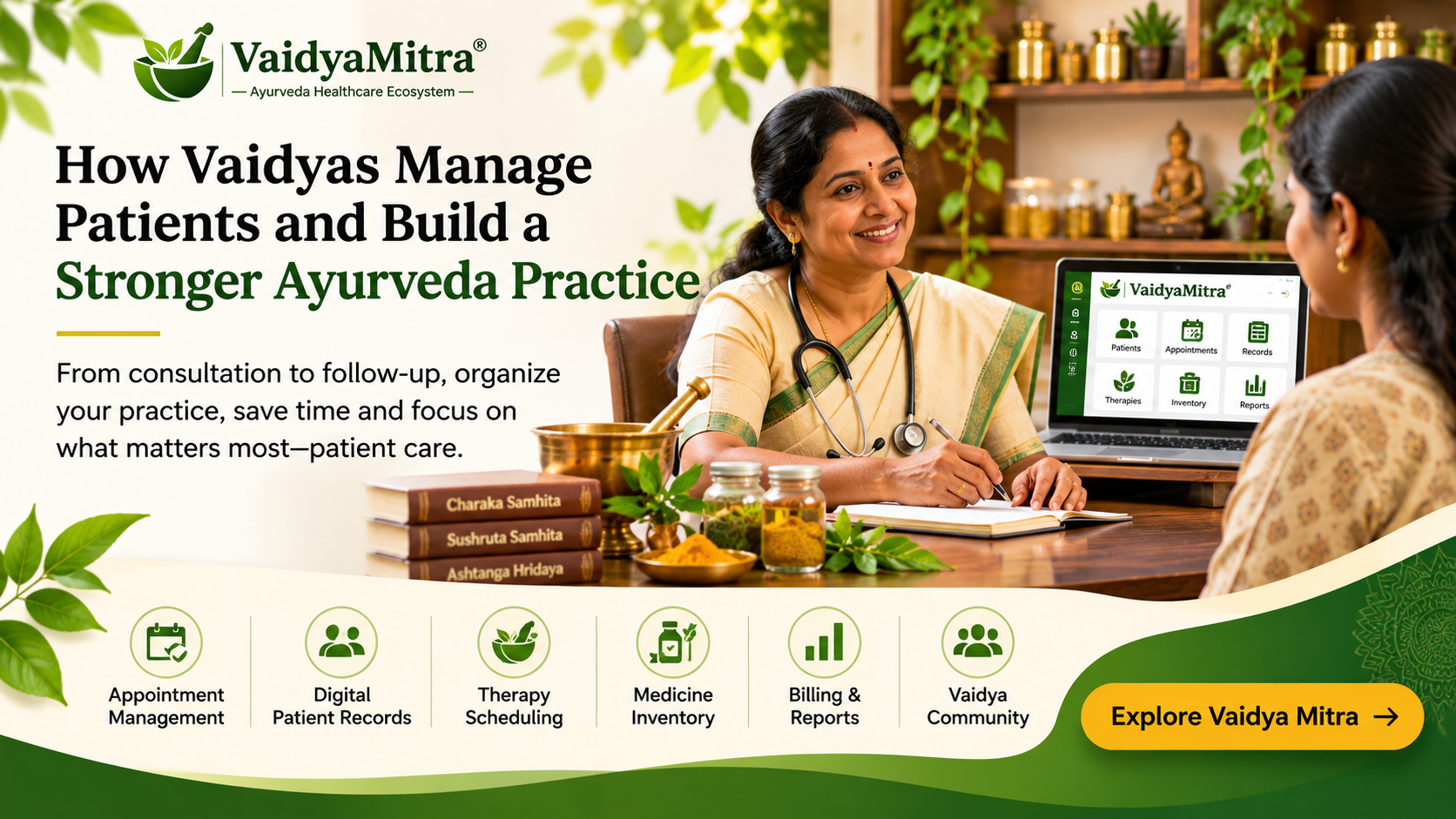
From first consultation to long-term follow-up, discover how modern Vaidyas manage patients, overcome everyday clinic challenges and grow a trusted Ayurveda practice.
Every morning, a Vaidya walks into the clinic with the same purpose: to understand each patient’s Prakriti, identify the Vikriti, and guide them toward balance. Yet by noon, much of the day is often spent on something else entirely: finding old records, confirming appointments, calling patients back, checking medicine stock and managing the front desk.
This is the quiet reality of Ayurveda clinical practice today. The clinical skill of a Vaidya is the foundation of the practice, but the way a practice is managed decides how many patients can be cared for well, how consistent the follow-up is, and how sustainable the work remains over the years.
In this article, we look at how Vaidyas manage patients today, the modern challenges they face, and practical ways to build a stronger, more organized Ayurveda practice.
In This Article
- A Day in the Life of a Vaidya
- How Vaidyas Manage Patients: The Patient Journey
- Modern Challenges Facing Vaidyas
- Five Practical Steps to Build a Stronger Ayurveda Practice
- Professional Development for Vaidyas
- Before and After: A Practice Scenario
- Frequently Asked Questions
A Day in the Life of a Vaidya
No two days in a Vaidya’s clinic are identical, but most follow a familiar rhythm:
- Morning: Consultations begin. Each one involves detailed history-taking, observation, pulse and physical examination, and a discussion of diet, lifestyle and daily routine.
- Midday: Therapies such as Abhyanga, Shirodhara or Swedana are supervised, and prescriptions and formulations are prepared or dispensed.
- Afternoon: Follow-up consultations, phone calls, and review of ongoing treatment plans.
- Evening: Records are updated, stock is checked, billing is completed and tomorrow’s appointments are reviewed.
Ayurveda is deeply individual. A treatment plan depends on the patient’s constitution, season, digestion, lifestyle and condition. That individuality is precisely why good records and consistent follow-up matter so much.
How Vaidyas Manage Patients: The Patient Journey
A well-run Ayurveda practice follows a clear patient journey. Each stage depends on the information collected in the one before it.
- Appointment and registration. The patient books a visit and shares basic details and the reason for the consultation.
- Consultation and assessment. The Vaidya records the history, symptoms, Prakriti and Vikriti observations, and examination findings.
- Treatment plan and prescription. This covers formulations, diet and lifestyle guidance, and any therapies such as Panchakarma.
- Therapy sessions. Sessions are scheduled with the right therapist, room and timing, and progress is noted.
- Follow-up. The patient returns for review, and the plan is adjusted based on response.
- Treatment history. Over time, a complete record shows what was done, what worked and what changed.
When this journey is handled on paper or across WhatsApp, spreadsheets and memory, the weakest link is usually the follow-up. Patients forget, notes are scattered, and the Vaidya spends the start of every consultation reconstructing the past.
Modern Challenges Facing Vaidyas
1. Rising patient expectations. Patients today are used to easy booking, reminders and quick responses. They compare their healthcare experience with every other service they use.
2. Scattered information. Records spread across notebooks, phones and files make it hard to see a patient’s full treatment history at a glance.
3. Follow-up gaps. Ayurvedic treatment often unfolds over weeks or months. Missed follow-ups can interrupt a plan that was working.
4. Administrative load. Billing, stock, staff scheduling and reports take time away from clinical work.
5. Medicine and supplier management. Tracking formulations, raw materials and reliable suppliers is a daily task in its own right.
6. Competition and visibility. Patients now search online before choosing a Vaidya. A strong reputation in the local community may no longer be enough on its own.
7. Regulation and data privacy. Practitioners must stay aware of professional regulations and handle patient information responsibly. Check current guidance from the Ministry of Ayush, NCISM and India’s Digital Personal Data Protection Act.
8. Limited time for learning. Busy clinics leave little room for case discussions, research updates and peer exchange.
Five Practical Steps to Build a Stronger Ayurveda Practice
1. Standardize how you record each consultation
Use a consistent structure for history, assessment, diagnosis, prescription and advice. A repeatable format saves time and makes every record easy to review later.
2. Make follow-up a system, not a habit
Decide the follow-up interval at the end of every consultation, and set reminders so that the patient and the clinic are both prompted. Reliable follow-up builds trust and supports better outcomes.
3. Digitize records and appointments
Moving to digital patient records and appointment management reduces repeated data entry and makes past treatment history available in seconds. Choose a system that supports Ayurvedic concepts and workflows, not just general medical templates.
4. Organize therapy and inventory
For clinics offering Panchakarma and other therapies, track sessions, therapists and rooms in one schedule. Keep a clear view of medicine stock so that a prescription is never delayed by a missing formulation.
5. Build your professional presence
Share educational content, patient guidance and your approach to practice. Clear, honest information helps patients choose a Vaidya with confidence. Avoid presenting any treatment as a guaranteed outcome.
Professional Development for Vaidyas
A successful practice is built on continuous learning as much as on systems. Consider:
- Case discussions with peers, to compare approaches and sharpen clinical reasoning.
- Continuing education such as workshops, seminars and conferences.
- Research awareness, by following published studies and evidence-based Ayurveda developments.
- Mentorship, both receiving guidance from senior Vaidyas and mentoring students and interns.
- Practice-management skills, including communication, finance and team leadership, which are rarely covered in clinical training.
A professional community makes all of this easier. When Vaidyas share experience, the knowledge no longer stays within a single clinic.
Before and After: A Practice Scenario
The following is an illustrative example, not a real case.
Before. Dr. Meera runs a busy Ayurveda clinic. Patient notes are in paper files, appointments are confirmed by phone and WhatsApp, and follow-ups depend on her receptionist’s memory. Each morning, about twenty minutes goes into locating files and confirming the day’s schedule. When a patient returns after three months, she reads through several pages to recall the earlier plan.
After. The clinic moves to a digital system. Records are structured and searchable, reminders are sent automatically, and therapy sessions are scheduled in a single calendar. Dr. Meera opens a patient’s history before they walk in. Follow-up visits rise because patients are reminded, and her team spends less time on routine administration.
The clinical approach has not changed. What has changed is the time and attention available for patients.
(Replace this with a real clinic example and measured results once you have permission to share them.)
The Vaidya Remains at the Centre
Technology cannot replace the judgment, experience and compassion of a Vaidya. Diagnosis, treatment decisions and the patient relationship stay with the practitioner. What good tools can do is remove friction around the clinical work: fewer missed follow-ups, less paperwork and clearer records.
Platforms such as Vaidya Mitra are designed to support this, with patient appointment booking, digital records, treatment history, therapy scheduling, clinic management and a community of Vaidyas, so that practitioners can spend more of their time on care.
Frequently Asked Questions
How do Vaidyas manage patient records? Traditionally on paper. Many practices are moving to digital records that store consultation history, prescriptions, therapy sessions and follow-ups in one place.
What are the biggest challenges for Ayurvedic doctors today? The most common are scattered records, follow-up gaps, administrative workload, inventory management, patient expectations and visibility to new patients.
How can a Vaidya grow an Ayurveda practice? By delivering consistent care, building a reliable follow-up system, sharing trustworthy educational content, and continuing professional learning and peer exchange.
Is digital practice management safe for patient data? It can be, when the platform follows sound security practices and the clinic complies with applicable data protection rules. Always verify how a provider stores and protects patient information.
What should an Ayurveda clinic software include? Appointments, structured patient records, prescriptions, therapy scheduling, follow-up reminders, medicine inventory, billing and reports, ideally designed around Ayurvedic workflows.
Conclusion
The practice of Ayurveda has always rested on the skill and dedication of the Vaidya. Today, that skill works best when supported by organized systems, consistent follow-up and a strong professional community.
Start small. Standardize your records, systematize follow-up, and invest in your own learning. Each of these steps gives you more time for what matters most: your patients.
Call to Action: Are you a Vaidya or clinic looking to manage patients, therapies and your practice from one place? Explore Vaidya Mitra →