
A Complete Guide to 10 Commonly Used Medicinal Plants
VaidyaMitra Team
03-11-2026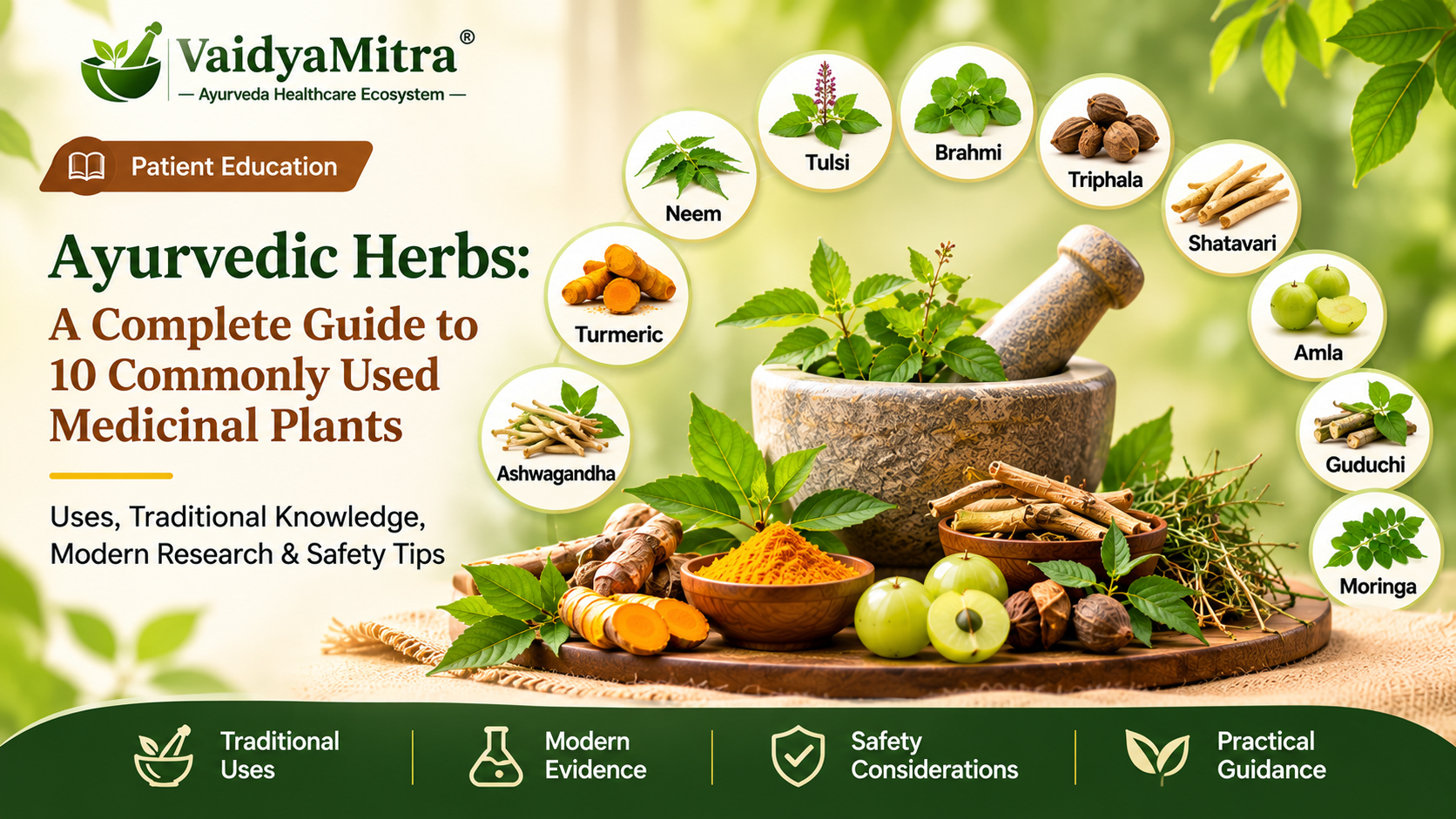
Explore 10 widely used Ayurvedic herbs: Ashwagandha, Turmeric, Neem, Tulsi, Brahmi, Triphala, Shatavari, Amla, Guduchi and Moringa. Learn their traditional uses, what research says and how to use them safely.
Ayurvedic Herbs: A Complete Guide to 10 Commonly Used Medicinal Plants
Herbs sit at the heart of Ayurveda. For thousands of years, Vaidyas have used medicinal plants in formulations, daily routines, diet and therapies to support health and balance. Today, these same herbs are among the most searched wellness topics in India and around the world.
But popularity brings confusion. Which herb is used for what? What does modern research actually say? And when should a herb be avoided? This guide answers these questions for ten of the most commonly used Ayurvedic herbs, in plain language and without exaggerated claims.
Important: This article is for educational purposes only. Ayurvedic herbs are not a substitute for diagnosis or treatment by a qualified doctor. Always consult a registered Vaidya or physician before using any herb, especially if you are pregnant, breastfeeding, taking regular medication or managing a medical condition.
What Are Ayurvedic Herbs?
Ayurvedic herbs are medicinal plants described in classical Ayurvedic texts such as the Charaka Samhita, Sushruta Samhita and Ashtanga Hridaya. Plant parts such as leaves, roots, bark, fruits and seeds are used on their own or combined into formulations such as churna (powder), kashaya (decoction), ghrita (medicated ghee), taila (medicated oil) and avaleha (herbal paste).
Ayurveda describes herbs through properties such as rasa (taste), guna (quality), virya (potency) and vipaka (post-digestion effect), and considers how a herb suits an individual's Prakriti (constitution) and Vikriti (current imbalance). This is why the same herb may be advised for one person and avoided for another.
Traditional Knowledge and Modern Evidence
Traditional use is valuable, but it is not the same as clinical proof. For many Ayurvedic herbs, laboratory and animal studies are promising, while high-quality human trials are still limited or small in size. In this article, we separate what is traditionally described from what has been studied in people, so you can read both with the right expectations.
1. Ashwagandha (Withania somnifera)
Traditional use: Classified as a Rasayana (rejuvenative) herb. The root is traditionally used for strength, vitality and general resilience.
What research suggests: Several small to moderate human trials have studied ashwagandha root extract for perceived stress, anxiety and sleep quality, with some showing improvements compared with placebo. Study quality and extract types vary, so results should be read with caution.
Safety notes: Generally avoided in pregnancy. Use with caution if you have thyroid disorders, autoimmune conditions or take sedatives. Rare cases of liver injury have been reported, so stop use and seek medical advice if symptoms such as jaundice or severe fatigue appear.
2. Turmeric (Curcuma longa)
Traditional use: Haridra is used in food, skin care and many Ayurvedic formulations. It is valued as a household spice and as a medicinal herb.
What research suggests: Curcumin, a compound in turmeric, has been studied for joint discomfort and inflammation. A well-known limitation is its poor absorption; piperine from black pepper is often added to supplements to improve it. Culinary turmeric and concentrated curcumin supplements are not the same thing.
Safety notes: High-dose supplements may interact with blood-thinning medicines and may not suit people with gallstones or bile duct problems.
3. Neem (Azadirachta indica)
Traditional use: Nimba is traditionally used for skin care and for purification-focused routines. Leaves, bark and oil have different uses.
What research suggests: Laboratory studies show antimicrobial and anti-inflammatory activity. Human evidence is limited, and most is for topical or oral-care use.
Safety notes: Neem oil should never be swallowed, and it is especially dangerous for infants and young children. Avoid in pregnancy and when trying to conceive unless advised by a doctor.
4. Tulsi (Ocimum tenuiflorum)
Traditional use: Also called holy basil, Tulsi is used in daily rituals, teas and formulations, particularly for respiratory comfort and general wellbeing.
What research suggests: Small human studies have explored Tulsi for stress and blood sugar markers. The studies are generally small and short, so larger trials are needed.
Safety notes: People taking diabetes medication or blood thinners should consult a doctor, as Tulsi may add to their effects.
5. Brahmi (Bacopa monnieri)
Traditional use: Brahmi is a Medhya Rasayana, a herb traditionally used to support memory, learning and mental clarity.
What research suggests: Some clinical trials report modest improvements in memory-related measures after around 12 weeks of regular use, though results are not consistent across studies.
Safety notes: Can cause digestive upset, nausea or drowsiness in some people. Note that in some regions the name "Brahmi" is also used for Centella asiatica (Mandukaparni), a different plant. Always confirm the botanical name on the product label.
6. Triphala
Traditional use: Triphala is a classical combination of three fruits: Amalaki (Emblica officinalis), Bibhitaki (Terminalia bellirica) and Haritaki (Terminalia chebula). It is traditionally used for digestion and gentle cleansing.
What research suggests: Studies suggest a mild laxative effect and antioxidant activity. Evidence for digestive and oral-health use exists but is limited in scale.
Safety notes: May cause loose stools or cramps, especially at higher doses. Avoid in pregnancy and during diarrhoea.
7. Shatavari (Asparagus racemosus)
Traditional use: Shatavari is traditionally regarded as a nourishing herb, especially in women's health, including lactation and general reproductive wellbeing.
What research suggests: Most evidence comes from laboratory and animal studies. Human clinical data is limited, so claims should be modest.
Safety notes: Seek medical advice before use during pregnancy or breastfeeding, or if you have hormone-sensitive conditions or kidney problems.
8. Amla (Emblica officinalis)
Traditional use: Amalaki is one of the most important Rasayana fruits, used fresh, dried, in chyawanprash and in many formulations.
What research suggests: Amla is a rich source of vitamin C and polyphenols. Small studies have looked at cholesterol, blood sugar and antioxidant markers, with mixed results.
Safety notes: Generally well tolerated as a food. Concentrated extracts may affect blood sugar and bleeding risk, so consult a doctor if you use related medicines or have surgery planned.
9. Guduchi (Tinospora cordifolia)
Traditional use: Often called Giloy, Guduchi is used in many formulations and is traditionally associated with general resilience.
What research suggests: Laboratory studies are promising, but human evidence is limited. Reports of herb-induced liver injury have been published in recent years, which is why quality and dosage matter.
Safety notes: Use under professional guidance. Avoid or be careful in autoimmune conditions, liver disease, pregnancy and before surgery, and watch blood sugar if you use diabetes medicines.
10. Moringa (Moringa oleifera)
Traditional use: Moringa leaves, pods and seeds are used as food and in traditional preparations. It is often called the drumstick tree in India.
What research suggests: The leaves are nutrient-rich, containing protein, vitamins and minerals. Evidence for specific health outcomes in humans is still limited.
Safety notes: Root and bark preparations are not recommended in pregnancy. Leaves and pods as food are generally considered safe in normal amounts.
How to Use Ayurvedic Herbs Safely
- Consult a qualified Vaidya. Herbs are chosen based on the person, not just the condition.
- Check quality. Choose products from licensed manufacturers with batch details. Poor-quality herbal products can contain contaminants such as heavy metals.
- Confirm the botanical name. Common names vary by region and can refer to different plants.
- Start with food-based use. Culinary use is generally gentler than concentrated extracts.
- Tell your doctor. Herbs can interact with prescription medicines.
- Do not stop prescribed medicines. Never replace prescribed treatment with a herb without medical advice.
- Watch for reactions. Stop use and seek care if you notice rash, severe digestive upset, yellowing of skin or eyes, or any unusual symptoms.
Herb Cultivation and Sourcing
The quality of an Ayurvedic herb starts with where and how it is grown. Soil, climate, harvest season, correct plant identification and proper drying and storage all affect the final product. As demand grows, sustainable cultivation and traceable sourcing are becoming essential, both for patient safety and to protect wild medicinal plant populations.
For clinics, reliable access to verified herbs and formulations is a daily challenge. A connected digital ecosystem can help Vaidyas discover trusted suppliers, compare products and manage medicine inventory in one place.
Frequently Asked Questions
What are the most commonly used Ayurvedic herbs? Ashwagandha, Turmeric, Neem, Tulsi, Brahmi, Triphala, Shatavari, Amla, Guduchi and Moringa are among the most widely used.
Are Ayurvedic herbs safe? Many are well tolerated when used correctly, but "natural" does not mean risk-free. Dose, quality, individual health and other medicines all matter.
Can I take Ayurvedic herbs with modern medicines? Some herbs interact with prescription drugs. Always inform both your Vaidya and your doctor.
Which Ayurvedic herb is best for stress? Ashwagandha and Tulsi are commonly discussed, and some small studies exist. A Vaidya can advise what suits your constitution and health history.
Can pregnant women use Ayurvedic herbs? Many herbs should be avoided or used only under supervision during pregnancy. Always consult a qualified practitioner first.
Do Ayurvedic herbs cure diseases? No herb should be presented as a guaranteed cure. Ayurvedic herbs are used to support health as part of a broader plan guided by a qualified practitioner.
Conclusion
Ayurvedic herbs carry centuries of traditional knowledge, and modern research is slowly adding evidence to what Vaidyas have long practiced. The best approach combines respect for tradition with honest, evidence-based communication: know the botanical name, understand the traditional use, read the research with caution and always seek professional guidance.
Whether you are a patient, a student or a practising Vaidya, understanding herbs safely is the first step to using them well.